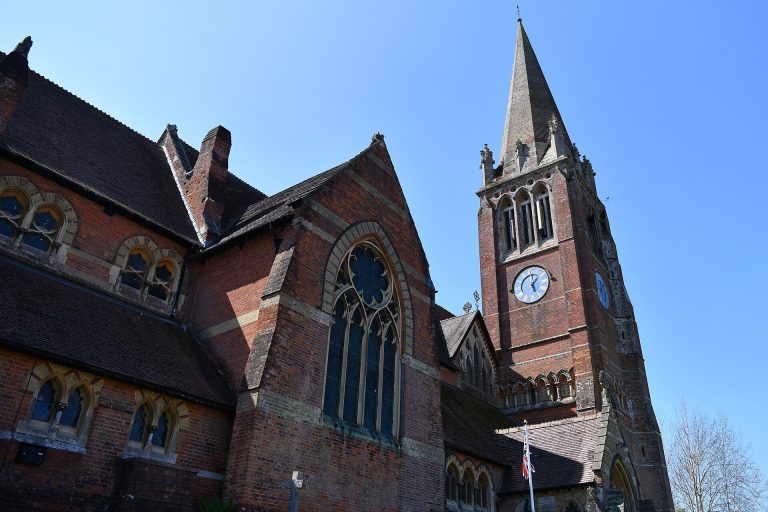
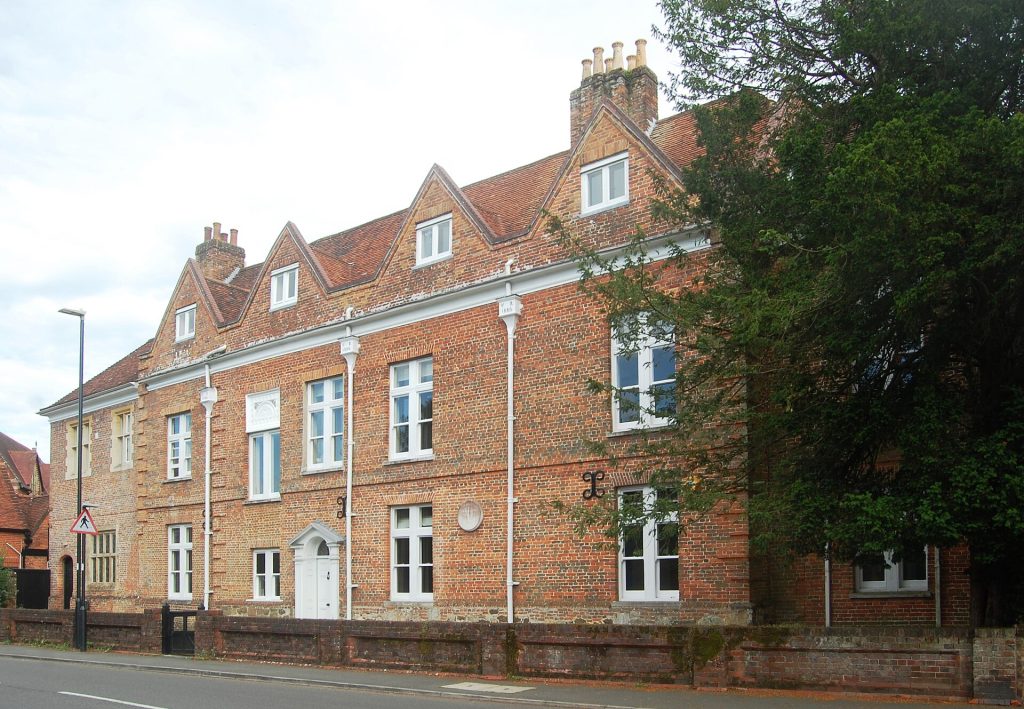
The long brick building beside St Michael’s church, at the top of Lyndhurst High Street, is the King’s House. It has been a royal hunting lodge, a home for the Lord Wardens of the Forest and, since the nineteenth century, the New Forest office of the Crown’s foresters, now Forestry England. While Elizabeth II was on the throne it was the Queen’s House. Since 2022 it has been the King’s House again, as it always is under a king. Inside is the Verderers’ Hall, where a court with medieval roots still meets in public most months of the year.
You can walk in and watch. Surprisingly few visitors do, which is a shame, because forty-five minutes in the Verderers’ Court will teach you more about how the New Forest really works than a day of reading.
A short history of the King’s House
There was a royal manor house at Lyndhurst by Edward I’s reign in the late thirteenth century, and a hunting lodge here by the fourteenth. Henry VIII had the old house repaired and enlarged. Charles I ordered a big rebuild in the 1630s, including new lodgings and stabling for the king, paid for partly by selling Forest timber, and the work was still unfinished when the Civil War broke out. Charles II completed it, spending heavily between 1669 and 1671.
The Lord Wardens of the Forest used the house until the death of the last royal warden, the Duke of Cambridge, in 1850. After that it became the home and office of the Crown’s deputy surveyor, the man who ran the Forest day to day, and it was heavily altered in 1851 before later restorations put much of it back. Historic England lists it at Grade II*, describing a building of medieval origin with Tudor elements, a seventeenth-century main structure and plenty of nineteenth- and twentieth-century repairs. George III, who stayed in June 1789, was the last monarch to sleep here.
The Verderers’ Hall
A hall was built inside the lodge in 1388, and the Forest courts have met in it, or on its site, ever since. The room you see today is much restored: Historic England dates the present court room to the eighteenth century. Its best-known fitting is the heavy oak dock, once for prisoners and now where the Head Agister stands to open the court. Deer heads hang on the walls, and older accounts also describe ancient tables and chairs and a royal coat of arms from the justice seat (a session of the senior forest court) held in 1669 to 1670.
More recently Forestry England led a full restoration of the hall as part of the National Park’s Our Past, Our Future landscape partnership. The tiled floor, bay window and stained glass were repaired, the heating and security were brought up to date, and the deer heads went back on the walls. A display cabinet and a screen for films about the Forest were added so the hall could be used for school groups and open days.
The Rufus stirrup
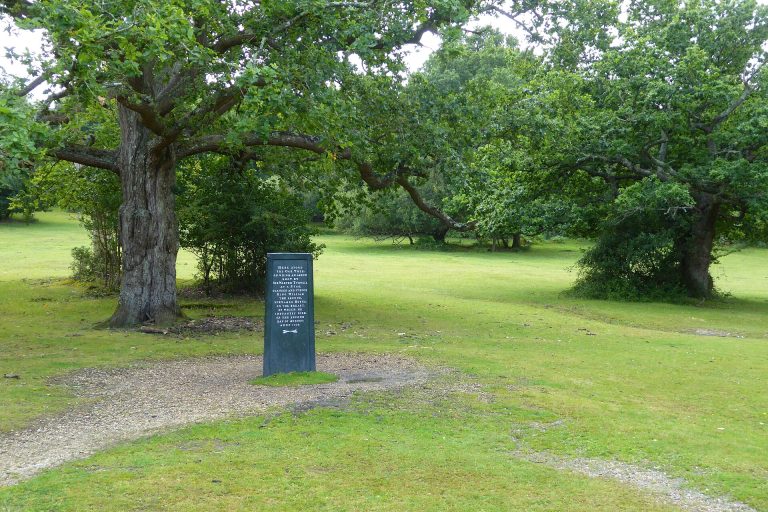
The best-known object linked to the hall is the so-called Stirrup of Rufus. Under forest law, ordinary people’s dogs living in the Forest had to be “lawed” (have claws cut from their front feet) so that they could not chase the king’s deer. The stirrup was the gauge: a dog small enough to squeeze through it was let off, and a bigger dog had to be lawed. The name ties it to William Rufus, who was killed in the Forest in 1100, but nobody has shown that it is anything like that old, and the Victoria County History of 1911 calls it “so-called” for good reason. You can read about Rufus’s death on our Rufus Stone page. A crown and stirrup still appear on the gold buttons of the agisters’ green uniform.
Who the Verderers are and what the court does
The Verderers started out in the thirteenth century as a local forest court, fining people for small offences against the king’s deer and woodland and passing serious cases up to higher courts. In the seventeenth and eighteenth centuries their job was mostly protecting oak grown for the navy. The New Forest Act of 1877 turned the court round to face the other way: it now protects the commoners’ rights and the open Forest itself. The 1949 Act gave the court its present shape and the power to make byelaws, and later Acts in the 1960s and 1970 added more duties.
There are ten Verderers. The Official Verderer, who chairs the court, is appointed by the King. Five are elected by commoners on the Forest’s electoral register, serve six-year terms and are unpaid. The other four are appointed by Defra, Forestry England, the National Park Authority and Natural England. The court has the same standing as a magistrates’ court, and Forestry England needs the Verderers’ agreement for things like new car parks or campsites on the open Forest.
In practice the Verderers run commoning. They register the brands that commoners put on their animals, collect the annual marking fee paid for each pony and cow turned out, approve the stallions allowed on the Forest and employ the agisters. Our guide to New Forest ponies and commoning explains the system in full.
Watching the Verderers’ Court: dates and times
Open Court is normally held on the third Wednesday of each month. The Verderers meet in private from 9.30am, Open Court (the part the public can attend) starts at 10am, and afterwards they go back into private committee. There is no court in August, and December is a committee meeting only, so the public cannot attend. A typical Open Court lasts about three quarters of an hour.
| Remaining 2026 date | Public? |
|---|---|
| Wednesday 18 November | Yes, Open Court at 10am |
| Wednesday 16 December | No, committee only |
Dates for 2027 had not been published when we wrote this (autumn 2026). Check the court dates page before you set off, and aim to be there before 10am, as the Verderers ask.
What happens at Open Court
The Head Agister, in green livery, acts as crier and opens the court from the old oak dock. The Official Verderer then hears presentments. A presentment is a short spoken statement to the court about anything to do with the Forest: a complaint, a worry or a question. Commoners make most of them, but anyone can, and you must hand in a written copy of what you say. If a presentment is contentious, the Verderers usually wait until the next Open Court before deciding, so that other people have the chance to answer it. The word goes back to the days when forest officers “presented” offenders to the court.
Subjects can be anything from road deaths of ponies and the state of grazing to planning applications, cycling events and new car parks. It is local democracy at its most direct, and sometimes its most heated.
The agisters
The Verderers employ five agisters, including the Head Agister, and each looks after a patch of the Forest. Their name comes from the medieval officers who collected grazing fees, and they used to be known as marksmen. Many are commoners themselves. They collect the marking fees in spring, check on the animals in all weathers on foot, by vehicle and on horseback, run the pony drifts (round-ups) from late summer into autumn, and clip the tail of each pony whose fee is paid, in a pattern that shows which agister’s area the owner lives in. They are also on call around the clock for ponies stuck in bogs, cattle in gardens and, far too often, animals hit by cars.
Open days at the Verderers’ Hall
The hall is not open for casual visits, because the building is a working office. In summer 2025 it opened on three weekdays from 11am to 3pm, run by volunteers from the New Forest Heritage Centre and Forestry England. Any future dates are announced on the Verderers’ website and at the Heritage Centre, which also has leaflets about the hall. The Heritage Centre museum, a few minutes’ walk away, covers forest law and commoning and is free.
Visiting: getting there, parking and food nearby
The King’s House is on the High Street at the western, uphill end of the village, next to St Michael and All Angels church. The postcode for the Verderers’ office is SO43 7NH. From the main car park by the Heritage Centre it is about five minutes on foot: walk up to the High Street and head west, uphill, towards the church spire. Our Lyndhurst parking guide covers the charges and the alternatives.
Since you will be next door anyway, go into the church for the Leighton fresco and the Burne-Jones windows (see our St Michael’s church guide). For something to eat, the Heritage Centre café is open every day (10am to 4pm in winter, 10am to 5pm from April to October), and the Fox & Hounds at 22 High Street serves food from noon. There are more choices on our cafés and pubs pages.
Frequently asked questions
Can anyone attend the Verderers’ Court?
Yes. Open Court is public and free. Arrive before 10am on the day; it is normally held on the third Wednesday of the month, apart from August and December.
Is it the Queen’s House or the King’s House?
Both. The name follows the monarch, so it is the King’s House at the moment, but after seventy years of Elizabeth II plenty of people still say Queen’s House.
Can I go inside the King’s House?
Only into the Verderers’ Hall, during Open Court or on an advertised open day. The rest of the building is offices.
What is a presentment?
A short statement made in person to the Verderers at Open Court, raising a concern, complaint or question about the Forest. Anyone can make one, and you must hand in a written copy.
For the wider story of the village, go back to our Lyndhurst history page.