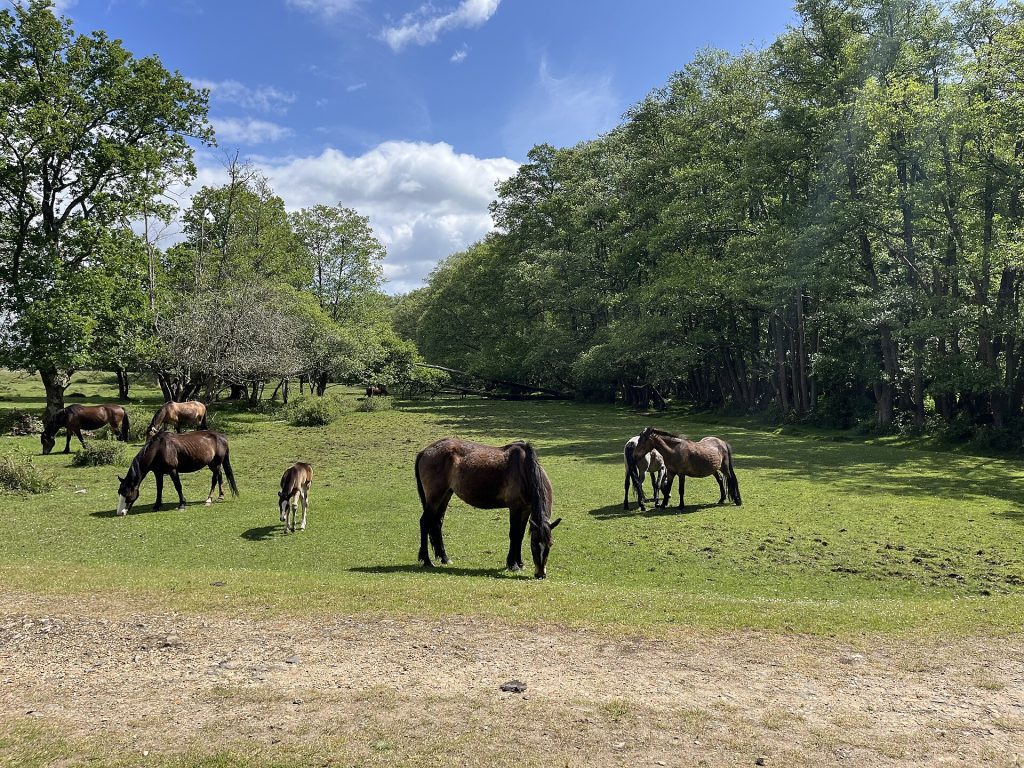
The ponies you meet on the verges outside Lyndhurst are not wild, and they do not belong to the National Park, Forestry England or the King. Every one of them is owned by a commoner, a local person with the right to turn animals out onto the open Forest, and every one is branded, counted and checked. Commoning, as the system is called, is older than the Norman forest, and without it the New Forest would look completely different.
This guide explains who owns the ponies, how the rights work, what the agisters and the autumn drifts are for, why you see ponies standing in the road, and why feeding them, however kindly meant, can get them killed.
Who owns the New Forest ponies?
Commoners do. A commoner is anyone who occupies land or a property that carries rights of common over the Forest. The rights belong to the land, not the person, so when a house with rights is sold, the rights go with it. Most commoners are small-scale: they keep a few ponies or cattle alongside a day job, and the income from the animals is small. A small number of families own most of the stock. Several hundred commoners use their grazing rights, and one widely quoted estimate is that about 80 per cent of the animals belong to around 10 per cent of commoning families.
Before an animal can go out, its owner registers with the Verderers, who allocate the family a brand. Each pony carries its owner’s brand, and the owner pays an annual marking fee for every animal turned out. The fee helps pay for the agisters, the Verderers’ staff who look after the stock on the Forest.
Commoners’ rights explained
There are six registered rights of common in the New Forest. The rights were confirmed by Acts of Parliament in 1698, 1877 and 1949, and any right not claimed under the 1949 and 1964 Acts was lost.
| Right | What it allows | Used today? |
|---|---|---|
| Pasture | Grazing ponies, cattle, donkeys and mules on the open Forest | Yes, the main right |
| Mast | Turning out pigs in autumn to eat acorns and beechmast (pannage) | Yes |
| Fuelwood (estovers) | A free allowance of firewood from Forestry England | Yes, for about 100 properties |
| Sheep | Grazing sheep | Rarely, by a few commoners |
| Turbary | Cutting peat for fuel | No |
| Marl | Digging clay to improve farmland | No |
The pigs get a season of their own every autumn; see our page on pannage. They are there for a reason: acorns are poisonous to ponies and cattle in quantity, but pigs eat them happily.
How many ponies are there in the New Forest?
The Verderers publish a count every year. In 2025 commoners turned out 5,495 ponies, along with 2,844 cattle, 643 pigs, 219 donkeys and 93 sheep: 9,294 animals in all. Pony numbers have stayed between about 5,400 and 6,000 every year since 2016. It has not always been like that: in 1945 there were just 571.
The grazing matters far beyond the ponies. Centuries of nibbling, trampling and browsing keep the heaths open, the lawns short and the woods light enough for the plants, insects and birds the National Park is famous for. Without the grazing, much of the open Forest would gradually scrub over.
The New Forest pony breed
The New Forest pony is a recognised native breed with a closed stud book, kept by the New Forest Pony Breeding and Cattle Society. The society was formed in 1937 by merging two older groups, one dating from 1891 and the other from 1905. A pure-bred New Forester can be up to 148 cm (just over 14.2 hands) tall, though ponies on the Forest are seldom under about 12 hands. Most colours are allowed, but not piebald, skewbald or blue-eyed cream.
The breed has had outside blood over the centuries. The Thoroughbred stallion Marske, sire of the great racehorse Eclipse, covered local mares in the 1760s, and Arab blood was brought in during the 1870s. Today the aim is a hardy pony that can live out on the Forest all year.
Stallions are tightly controlled. Only registered New Forest stallions approved by the Verderers may run on the Forest, and only for a limited spell in spring and summer. In 2026, 25 were turned out for six weeks from 11 May, under a stewardship scheme that has paid for grazing for up to 30 stallions a year since 2010.
Agisters, drifts and tail marks
The Verderers employ five agisters, each responsible for an area of the Forest. They check on the stock on foot, by vehicle and on horseback, collect the marking fees in spring, report animals that are unbranded or unpaid, and are on call around the clock for ponies stuck in bogs and ditches, cattle in gardens, colic from eaten garden waste, and road accidents. More about their history is on our Verderers’ Court page.
Between mid-August and early November the agisters and commoners run about 40 drifts, three or four a week. In 2026 an equine flu outbreak held them back, and the drifts ran from 2 October to 7 November instead. Riders round up the ponies in one area, often 50 to 150 at a time, and bring them into a pound. Each pony is checked and counted against the marking fee records. Owners can take home foals to sell or ponies they want to keep in over winter, ponies can be branded, and owners can ask for reflective collars to make them more visible at night. The rest have their tails clipped and go back out for another year.
That clipped tail is the mark you can learn to read. A cut tail shows the fee has been paid, and the pattern of the cut shows which agister’s area the owner lives in.
Why do New Forest ponies stand in the road?
Because the road is part of their home. The Forest’s main roads are unfenced, and the verges are some of the best grazing around. Ponies have no road sense, and Forest animals have right of way. Cattle grids at the edge of the open Forest keep them in, not off the tarmac. All unfenced Forest roads have a 40 mph speed limit, and on a dark wet night that is far too fast.
The cost is real. In 2025 there were 108 recorded road accidents involving commoners’ animals, 47 animals died, and 18 drivers failed to report hitting one. November and December are the worst months, with dark evenings and animals on wet, unlit roads.
Why feeding the ponies is harmful (and illegal)
A pony that is fed by people learns to come to people. Fed ponies hang around car parks and roadsides waiting for the next sandwich, which is exactly where they get hit. They can turn pushy, and a nip or a kick from a pony that has learned to expect food can do real damage, especially to small children. Bread, crisps and fruit are also bad for a digestive system built for gorse, grass and heather, and colic can kill.
Since 1 July 2023 New Forest District Council has made it an offence, in its restricted areas, to feed or leave food for any New Forest pony, horse, mule or donkey, or to pet or touch one. The order was renewed for three more years from 1 July 2026. Breaking it can mean a fixed penalty of up to £100, or a fine of up to £1,000 if it goes to court. The safe rule everywhere is simple: admire them from a distance, and keep your picnic packed away. Our guide to the New Forest Code covers the other basics.
How to report an injured New Forest pony
If you hit a pony, cow, donkey, pig, sheep or dog, you must report it to the police as soon as possible and within 24 hours, and deer collisions should go to the police too. Call 999 straight away, even if the animal runs off, because it may be badly hurt inside. The numbers below come from the National Park Authority’s animal emergency card; save them in your phone before you drive.
| Situation | Who to call | Number |
|---|---|---|
| Road accident involving a Forest animal | Police | 999 (emergency) or 101 |
| Sick, injured or distressed pony, cow, donkey, pig or sheep | Verderers’ office (Mon to Fri, 9am to 5pm) | 023 8028 2052 |
| Sick, injured or distressed animal, including deer, any time | Forestry England (24 hours) | 0300 067 4600 |
Where to see ponies near Lyndhurst
You rarely have to look hard. Bolton’s Bench, on the eastern edge of the village, is open Forest where ponies often graze, a few minutes’ walk from the High Street; our Bolton’s Bench walk starts there. Matley Heath, a short drive east, is another good spot (see our Matley Heath walk). On the heaths, remember that ground-nesting birds breed from 1 March until late August, so keep to the main tracks and keep dogs close; see our ground-nesting birds page.
To understand what you are looking at, start at the New Forest Heritage Centre in Lyndhurst’s main car park. Its free museum explains who owns the ponies and how the old laws still work, and its café is open daily (10am to 4pm in winter, 10am to 5pm from April to October). The Fox & Hounds on the High Street serves food from noon.
Frequently asked questions
Are New Forest ponies wild?
No. They live out on the Forest all year and are rarely handled, but every pony is owned by a commoner, branded and checked each autumn.
Can I touch or feed the ponies?
No. It is harmful to the ponies and, in the restricted areas covered by the council’s order, an offence with fines of up to £1,000.
What should I do if I hit a pony?
Stop when it is safe and call 999, even if the animal runs away. You must report it to the police within 24 hours.
How many ponies are in the New Forest?
The Verderers recorded 5,495 ponies turned out in 2025, out of 9,294 commoners’ animals in total.
For the rest of Lyndhurst’s story, see our Lyndhurst history page.