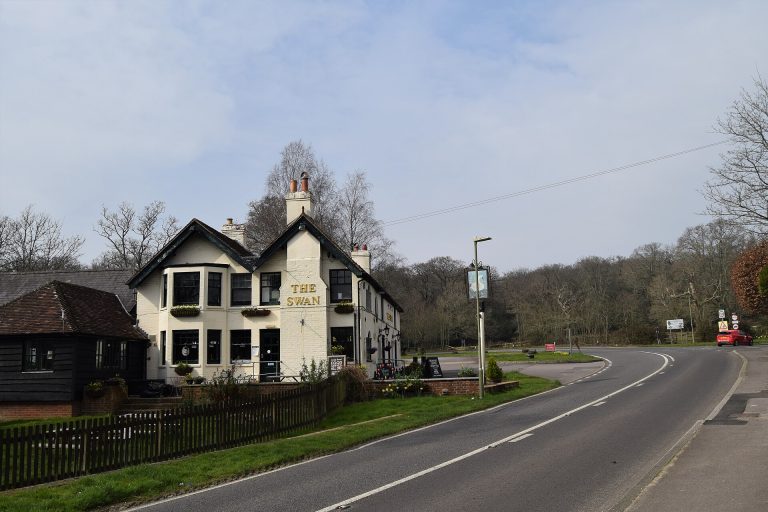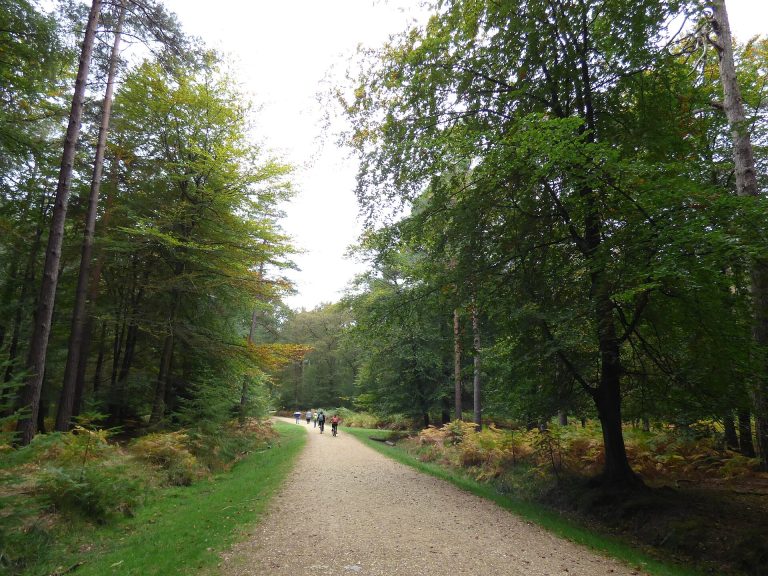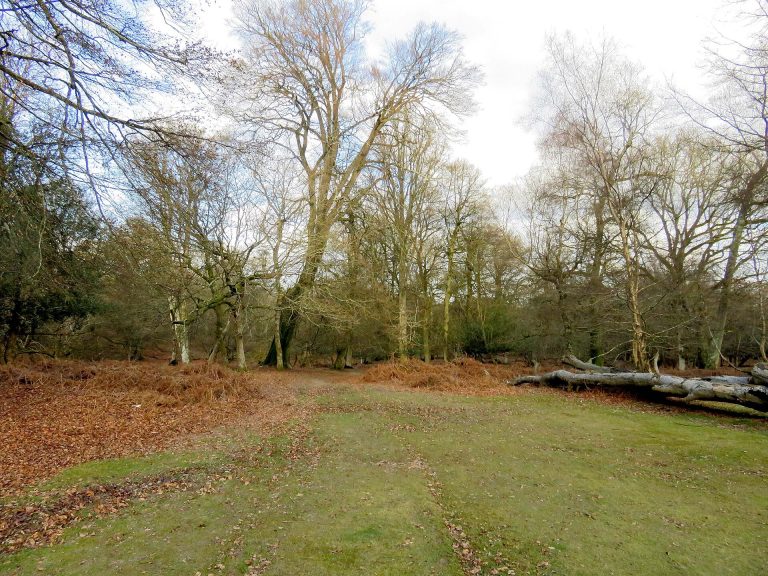
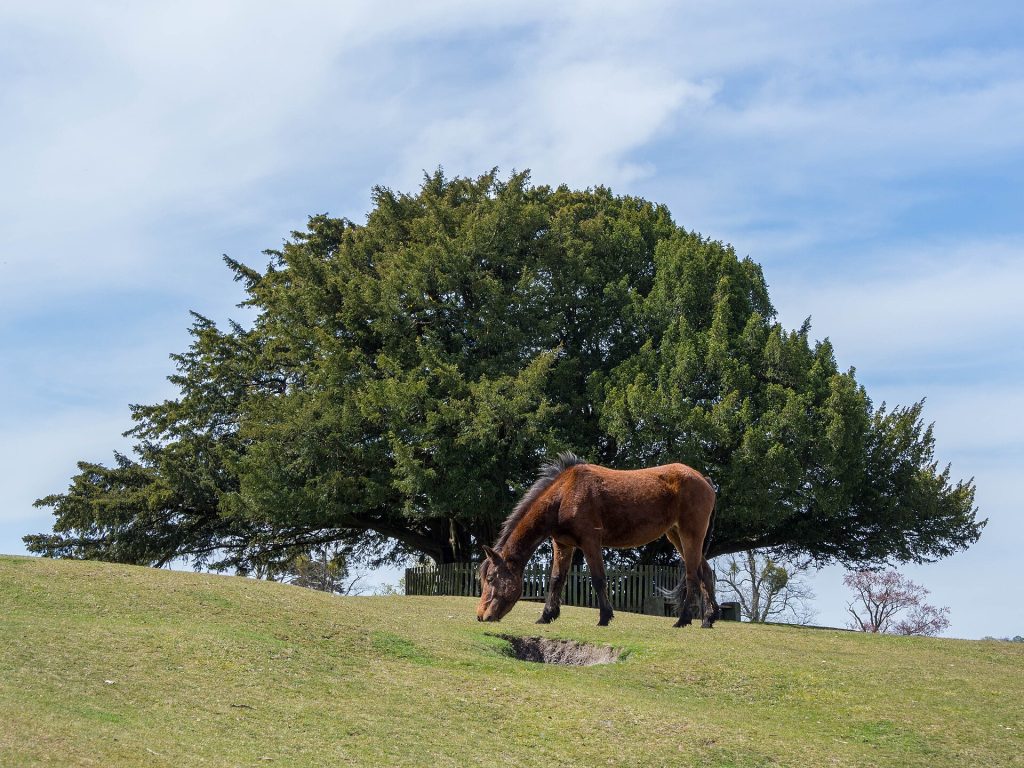
Bolton’s Bench is the little hill at the eastern end of Lyndhurst: a grassy hump topped with old yew trees and ringed with benches. It is the first piece of open forest you reach when you walk out of the High Street, and it is close enough that plenty of people stroll up with a coffee and stroll straight back down again. This walk goes further, using the hill as the start of a loop across White Moor, the open heath that runs east of the village towards Matley.
The loop is about 2.2 miles. Most of the outward leg is on a firm gravel track, and the return is on grass and heather paths. It is a good choice if you want a real taste of New Forest heathland without getting back in the car, and it makes an easy hour with a dog before lunch in the village.
Getting to Bolton’s Bench
On foot from the village centre
From the main car park behind the New Forest Heritage Centre, walk up to the High Street and turn right. Use the pedestrian crossings to get over the main road, carry on past the car showrooms at the eastern end of the street, and a small gate lets you out onto the forest. Cross Beaulieu Road carefully and the hill is in front of you. It takes about ten minutes. The National Park’s short accessible trail follows the same line, on pavement until the final grassy stretch up to the yews.
By car
Leave the village on the A35 towards Southampton and turn right onto the B3056 Beaulieu Road, opposite the fire station. Bolton’s Bench car park is straight away on your left, beside the war memorial. Forestry England runs it, it holds about 20 cars and it has no toilets. Two bigger Forestry England car parks, Bolton’s Queens and Bolton’s Cricket, are close by if it is full. Like every Forestry England car park in the Forest, all three have charged since April 2026: at the time of writing (autumn 2026), £1.50 for an hour, £3 for two hours, £5 for four hours and £8 for longer. They are among the 16 Forestry England car parks with card machines, or you can pay with RingGo by app, website or phone. One ticket covers any Forestry England car park in the New Forest, as long as it covers your total stay. Our parking guide covers the village car parks as well.
The route: a Bolton’s Bench and White Moor loop
This walk has no waymarks. The outward half follows an obvious gravel track and is hard to get wrong. The return crosses open heath, where several faint paths run side by side, so carry OS Explorer OL22 or have a mapping app on your phone, and use the landmarks below. Distances are approximate.
1. Over the hill
From the car park, climb the short slope to the yews on top of Bolton’s Bench. It takes a minute or two. Sit on one of the benches and look east: the open ground spread out below you is White Moor, and that is where you are heading.
2. Past the cemetery and the cricket ground (about a quarter of a mile)
Drop down the far side of the hill to the tarmac access road and follow it east. It turns to gravel as it passes Lyndhurst cemetery on your left and then the cricket ground, with the Bolton’s Cricket car park alongside. At the far end of the car park a barrier leads out onto the heath.
3. East across White Moor (about three quarters of a mile)
Beyond the barrier, a broad gravel track heads east-south-east across White Moor, more or less parallel with Beaulieu Road, which stays a couple of hundred metres away on your right. The walking is easy and the views open up quickly. You pass the low rise of Whitmoor Hill on your right early on, and later the track runs over a gentle ridge before it starts to drift towards the road.
4. Back across the top of the heath (about 1.2 miles)
Roughly a mile from the car park, where tracks cross, turn left and head north-west up the slope on a grassy path. After about a third of a mile, bear left and follow the paths running west across the top of White Moor. There are several sandy paths here and it hardly matters which you choose, as long as you keep heading west with the A35 some way off to your right. The cemetery comes back into view ahead, and a short path brings you down to the cricket ground and the access road. Walk back past the hill to the car park.
If you want something longer, Pondhead Inclosure lies on the other side of Beaulieu Road. In Williams Copse there, a small plaque says that 900 sessile oaks were planted in 1979 to mark 900 years since William I created the New Forest. You will need the map to link it in, and take care crossing the road.
What you will see on Bolton’s Bench and White Moor
The hill takes its name from the Duke of Bolton. Charles Paulet, Lord St John of Basing, was Lord Warden of the New Forest in the late 17th century and was made Duke of Bolton in 1689. Whether he ever sat here is anyone’s guess, but the name stuck. Forestry England describes the yews on top as ancient, and they make the hill a shady place to sit on a hot afternoon.
Next to the car park stands Lyndhurst’s war memorial, a cairn of Cornish granite boulders topped with a Celtic cross. It was unveiled on 4 September 1921, and the design idea is said to have come from Alice Hargreaves, who as a child was the Alice Liddell of Alice in Wonderland and who lost two sons in the First World War. Our page on Alice Liddell in Lyndhurst tells more of her story.
White Moor itself is classic New Forest heath: heather, gorse, birch scrub and close-cropped grass kept short by ponies and cattle. Late summer is the time to come for colour, when the heather turns purple. In autumn the bracken goes copper, and on a frosty winter morning the gorse is strung with cobwebs. Heaths like this are where the Forest’s Dartford warblers and woodlarks nest, which is why the spring advice about sticking to the main track matters.
Terrain, mud and accessibility
The access road and the gravel track are firm in all weathers. The heath paths on the way back are a mix of grass, sand and heather, dry and dusty in summer and damp in the dips after winter rain. Walking boots are usually enough, though wellies help after a long wet spell. There are no stiles, just a vehicle barrier where the track meets the heath, and the only climb is the short slope up the hill.
An all-terrain buggy will cope with the gravel track as an out-and-back walk, but the heath paths are too rough for most pushchairs. Wheelchair users can reach the hill itself on the National Park’s accessible trail from the village car park, which has accessible toilets; the last part is on grass. See our accessibility guide for more step-free options.
Walking with dogs
Ponies and cattle graze White Moor and the slopes of the hill. They belong to local commoners, so keep your distance, give mothers with young a wide berth, and never feed or stroke them. Keep your dog close and do not let it approach or chase any animal. If cattle do come at you, let the dog go so you can both get away separately.
Beaulieu Road is an unfenced forest road with a 40 mph limit and animals wander across it, so use a lead in the car park and near the road. From 1 March until late August, keep dogs on the main gravel track and on a lead if their recall is shaky; there is more on why on our ground-nesting birds page. There is no reliable water on the heath, so carry some on warm days, and check for ticks after walking through bracken in summer. Our dog walks guide has more ideas nearby.
Food and drink nearby
You are only about 400 metres from the High Street. The Fox & Hounds, a Fuller’s pub in a former coaching inn, is the nearest, and its website lists it as dog friendly. The High Street also has several cafés and tea rooms (see our cafés guide). The nearest public toilets are at the main village car park.
Frequently asked questions
How long does the Bolton’s Bench walk take?
Just going up the hill and back from the car park takes ten minutes. The full White Moor loop is about 2.2 miles and takes an hour to an hour and a half at an easy pace.
Can I walk to Bolton’s Bench from Lyndhurst High Street?
Yes. It is about ten minutes on foot from the main village car park, mostly on pavement.
Is there free parking at Bolton’s Bench?
No. Since April 2026 every Forestry England car park in the New Forest charges. At the time of writing it is £1.50 for an hour, paid by card or RingGo.
Why is it called Bolton’s Bench?
It is named after the Duke of Bolton, who was Lord Warden of the New Forest in the late 1600s.
To see this walk alongside the others, open our walks map. For more open heath, try the Matley Heath and Matley Wood walk a couple of miles along the same road, or head the other way out of the village on the Emery Down and Swan Green loop.