On 2 August 1100 King William II, called Rufus, was killed by an arrow while hunting in the New Forest. Within three days his younger brother Henry had seized the treasury at Winchester and been crowned in Westminster Abbey. It was either a hunting accident or the most efficient murder in English history, and people have been arguing about which ever since.
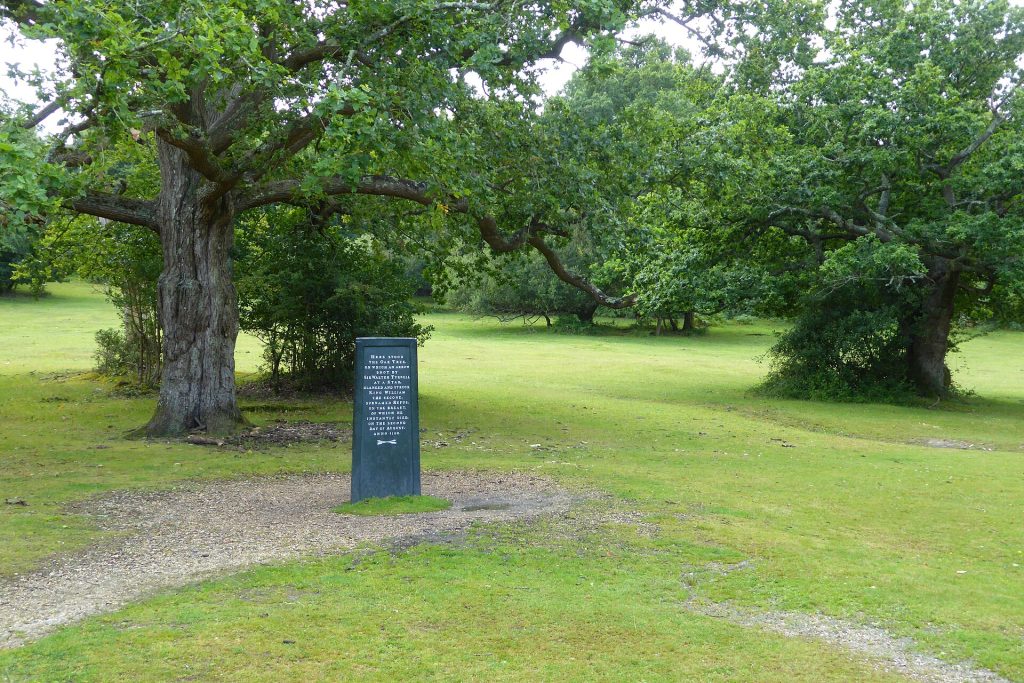
The Rufus Stone, in a quiet clearing near Minstead about three miles north-west of Lyndhurst, marks the spot where tradition says he fell. Whether it is the right spot is another argument. Here is the story, the evidence, and what you will find when you go.
Who was William Rufus?
William was the third son of William the Conqueror and Matilda of Flanders, born around 1057 in Normandy. The nickname Rufus is Latin for “the red”, probably for his red hair or ruddy face. He became king of England when his father died in 1087, while his elder brother Robert got Normandy, and the two spent much of the next decade quarrelling over the inheritance.
He was a capable soldier and a tough king, but he fell out badly with the Church, kept bishoprics empty so he could pocket their income and drove Archbishop Anselm into exile. The men who wrote the history of his reign were monks, and they did not like him. That colours almost everything we know about how he died.
He was also not the first of his family to die in this forest. His older brother Richard was killed while hunting here some time between 1069 and 1075, and to medieval writers the Forest looked like a curse on the family that had made it.
How William II died in 1100: the accounts
The earliest record, the Anglo-Saxon Chronicle, says only that the king was shot with an arrow by one of his own men while out hunting. Later chroniclers, writing a generation on, filled in the details. William of Malmesbury and Orderic Vitalis both name the man who fired the arrow as Walter Tirel, a nobleman from northern France, and describe an arrow meant for a stag hitting the king in the chest instead. The arrow went into his lung and he died almost at once.
What happened next is not in much doubt. The nobles in the hunting party rode off, the body was left lying where it fell, and according to William of Malmesbury a few local countrymen put it on a cart and took it to Winchester, where it was buried in the cathedral. (The tomb in the cathedral long called his is now thought to belong to a later bishop, Henry of Blois.)
Henry, who was in the hunt that day, did not wait. He rode straight to Winchester, took control of the castle and the royal treasury, and was crowned at Westminster on 5 August by the Bishop of London, because the Archbishop of Canterbury was still abroad. His brother Robert, who had a strong claim of his own, was on his way back from the First Crusade.
Walter Tirel: guilty, framed or nowhere near?
Walter Tirel was lord of Poix in Picardy and held land at Langham in Essex. He had married Adeliza, daughter of Richard fitz Gilbert of the powerful Clare family, and he was known as a fine shot with a bow. Straight after the king’s death he fled to France, which looked bad.
And yet he denied it for the rest of his life. Abbot Suger, a well-connected French churchman who knew him, wrote that he had often heard Tirel swear on oath that he had not been in the part of the Forest where the king was hunting that day and had not even seen him. Once he was safely home, with no one pursuing him, he had little obvious reason to keep lying, which makes his denial harder to brush aside.
Accident or assassination?
The case for murder is easy to make. Henry wanted the throne, Robert was about to come home and claim it, and Henry moved with a speed that looks prepared. A skilled archer making a fatal mistake also seems a little convenient, and the historian Austin Lane Poole thought the facts looked thoroughly suspicious.
The case against is just as strong. Hunting accidents with arrows were common, and the Conqueror’s family had already lost one son to the Forest. John Gillingham pointed out that Henry had little reason to risk murder at that moment, since a war between William and Robert was coming anyway and might have removed one of them for him. Frank Barlow, William’s biographer, concluded that there is simply not enough evidence to call it murder. Our own view, for what it is worth, is that nobody will ever know, and that is half the fun of standing in the clearing.
Local folklore has reached its own verdict. One story says Tirel stopped to wash the king’s blood from his hands in Ocknell Pond, near Stoney Cross, and that the water turns red once a year. Another tells of a ghostly black dog called Tirel’s Hound.
Where did Rufus really die?
No early source says exactly where the king was killed. The first writer to name a place was the antiquary John Leland around 1530, who called it Thorougham, a name no longer used. It probably referred to land at what is now Park Farm on the Beaulieu estate, and a memorial stone at Beaulieu Abbey says he died in the area then called Truham. Other historians simply say the Forest near Brockenhurst.
The Canterton site, where the Rufus Stone stands, only enters the story in the seventeenth century, when Charles II seems to have been shown a suitable oak tree on a visit. By the eighteenth century the tree was gone, reportedly cut down and burned. So the stone marks where people have long believed the king fell, not a place anyone can prove.
The Rufus Stone and its inscriptions
The first stone was put up in the eighteenth century by John, Lord Delawarr, who said he had seen the tree still growing. It stood about five feet ten inches tall with a stone ball on top. George III and Queen Charlotte came to see it in 1789, and a line was added to record the royal visit.
Over the years the stone was vandalised and its inscriptions defaced. In 1841 William Sturges Bourne, then Warden of the Forest, had the stone enclosed in the three-sided cast iron casing you see today, with the old wording recast in iron. One side tells the traditional story: Tyrrell’s arrow at a stag, the glance off the oak, the king struck in the chest and killed on 2 August 1100. A second side says the body was laid on a cart belonging to a man called Purkis and taken to Winchester for burial in the cathedral. The third explains Lord Delawarr’s original stone and the 1841 iron replacement.
The Purkis story deserves a raised eyebrow. The Purkis family were charcoal burners who lived at Canterton until the end of the nineteenth century, and in 1806 one of them sold a bridle he claimed had belonged to the king, and said he still had a wheel from the cart. Victorian writers repeated it happily. The medieval accounts say only that local countrymen carried the body.
Another object tied to Rufus by name, an old stirrup used to measure dogs under forest law, belongs to the Verderers in Lyndhurst; see our page on the King’s House and the Verderers’ Court.
Visiting the Rufus Stone today
The stone stands in a grassy clearing among trees at Canterton, just north of the A31 between Cadnam and Stoney Cross, about three miles north-west of Lyndhurst as the crow flies. The quickest way to find it is to put “Rufus Stone” into a sat nav or map app; the Sir Walter Tyrrell pub next door uses the postcode SO43 7HD. You will hear the traffic on the A31 from the clearing, which takes a bit of the romance out of it, but on a misty autumn morning it still feels like a place where something happened.
The Forestry England car park is right beside the stone, only a few steps away. Since 20 April 2026 Forestry England charges at all its New Forest car parks, including this one. At the time of writing (autumn 2026) it costs £1.50 for an hour, £3 for two hours, £5 for four hours and £8 for longer, paid through RingGo by app, website or phone, and one payment covers all Forestry England car parks in the New Forest. We know of no public toilets at the stone, so plan for that. More detail is in our parking guide.
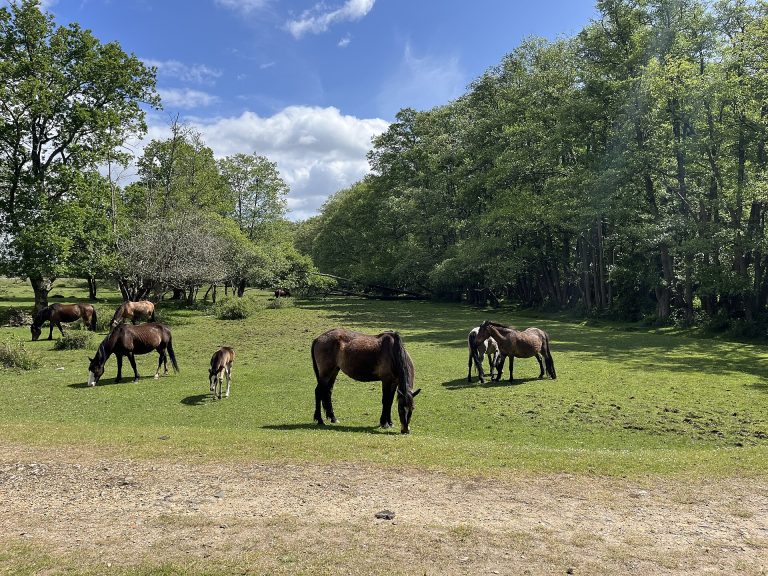
Ponies and cattle roam this part of the Forest, so expect company in the clearing. They belong to commoners, so do not feed or touch them (see New Forest ponies and commoning). Bring a lead for the dog, especially near the road.
Walking to the Rufus Stone and food nearby
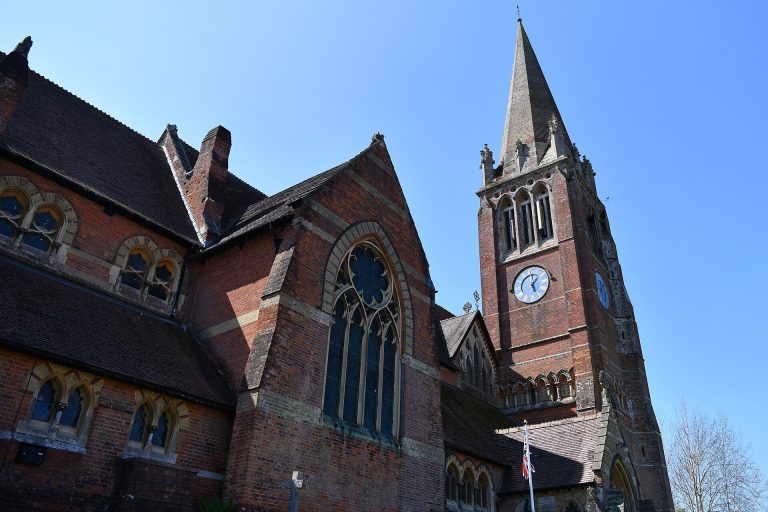
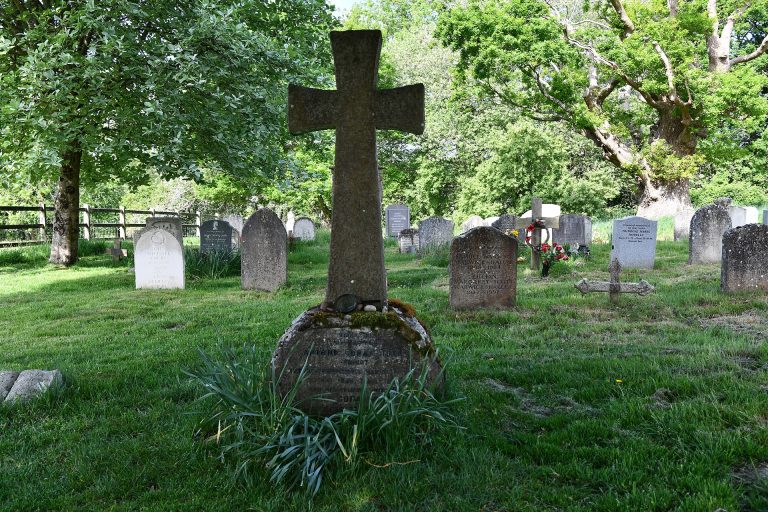
The nicest way to arrive is on foot. Our Minstead and Rufus Stone walk links the stone with Minstead village and All Saints’ church, where Arthur Conan Doyle is buried (see our Conan Doyle page).
For food, the Sir Walter Tyrrell is the pub beside the clearing; check its website or ring 023 8081 3170 for current opening and food times. In Minstead, the Trusty Servant serves breakfast and then food all day, every day. More options are on our pubs page.
Frequently asked questions
Is the Rufus Stone where William Rufus actually died?
Nobody knows. The site was first linked to his death in the seventeenth century. The earliest named location, recorded around 1530, points to the Beaulieu area instead.
Who killed William Rufus?
Medieval chroniclers blamed Walter Tirel, but Tirel always denied it on oath. Whether it was an accident, a mistake by someone else or a planned killing is still debated.
Is there parking at the Rufus Stone?
Yes, a Forestry England car park right next to the stone. Parking has been charged through RingGo since 20 April 2026, from £1.50 for an hour.
How long do you need at the Rufus Stone?
Ten minutes to read the inscriptions, longer if you walk in from Minstead or stop at the pub. It pairs well with Minstead church and Conan Doyle’s grave on the same morning.
For the wider story of the Forest and the village, see our Lyndhurst history page.