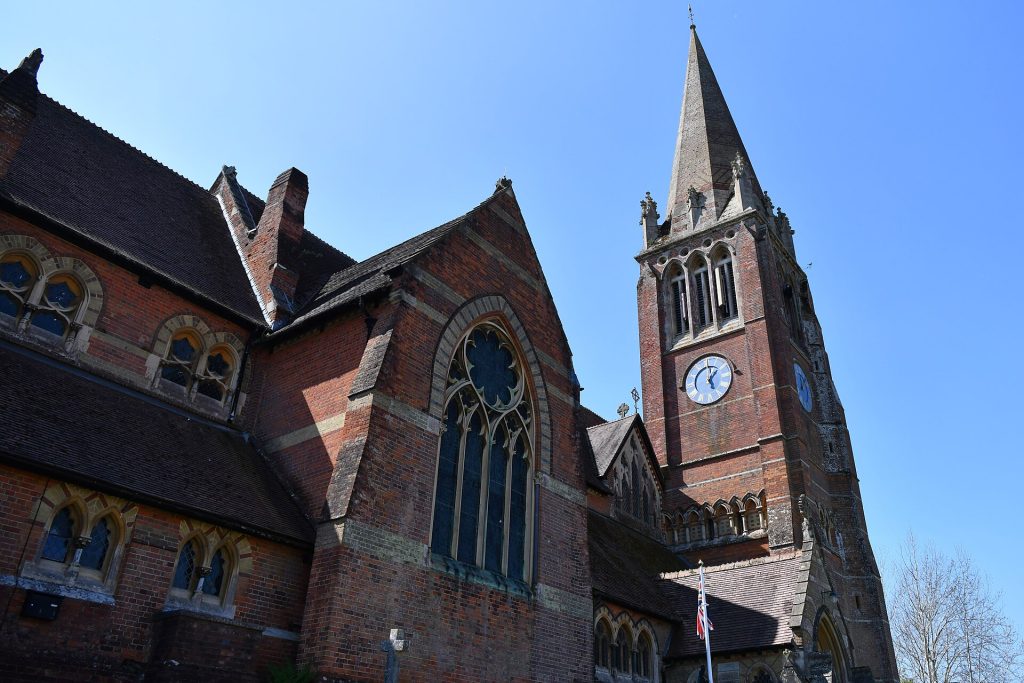
St Michael and All Angels is the big striped brick church on the hill at the top of Lyndhurst High Street, and you can see its spire from most of the village. Inside is, to our eyes, one of the best Victorian church interiors in the south of England: a huge fresco by Frederic Leighton, some of the earliest stained glass made by William Morris’s firm, to designs by Edward Burne-Jones, and carved angels the size of people looking down from the roof. It is free to visit and usually open every day.
If you have come for Alice Liddell’s grave in the churchyard, go inside as well. Give it half an hour, longer if you like glass.
A short history of St Michael’s church
There has been a place of worship on this hill for over seven hundred years. In 1285 Eleanor of Castile, Edward I’s queen, made an offering in the King’s Chapel at Lyndhurst, which stood next to the royal lodge that is now the King’s House. A plain Georgian church replaced it in 1741, and by the 1850s that was too small for the growing village.
The rector, John Compton, wanted something grand, with a fine spire and a full ring of bells. He hired William White, a Gothic Revival architect then in his early thirties, and work began in 1858. The new church cost about £9,000, roughly three times what a typical Victorian parish church cost at the time. Local people raised much of it, and Queen Victoria gave £300 because Lyndhurst was a royal manor. Building took about a decade.
The church is listed Grade I, the highest grade. Historic England’s listing calls the exterior White’s masterpiece, then says the interior outshines it. When part of the mound under the church was dug away for a new driveway in 2011, archaeologists found evidence of a twelfth-century settlement and religious activity on the site, and showed that the hill is natural.
The building: brick, angels and a 160-foot spire
White built in brick rather than stone, and he made the most of it. The outside is banded and patterned in red, yellow and white brick with stone dressings, under a tiled roof, and the tower at the north-west corner carries a spire of about 160 feet. It is said you can see it from the Isle of Wight on a clear day.
Inside, the brick is left bare, and the effect is warm and surprisingly big. Look at the tops of the nave columns: each one is carved with a different plant, the work of the sculptor G.W. Seale, who also made the pulpit and the screen. The columns themselves are clusters of eight shafts of dark Purbeck marble. Then look up. Large carved wooden angels sit on the roof timbers along the nave, and they are the thing children remember. There are also wall paintings on the south side from around 1860 by John Hungerford Pollen.
The Leighton fresco: the Wise and Foolish Virgins
Behind the altar, below the east window, is a wall painting more than seven metres wide by Frederic Leighton, later Lord Leighton and President of the Royal Academy. It shows the parable of the Wise and Foolish Virgins: the five wise women with their lamps lit, ready for the bridegroom, and the five foolish ones who let their oil run out and are shut outside. Leighton worked on it between 1862 and 1864.
He was in Lyndhurst because his mother was staying here while the church was being built. He offered to paint the wall for the cost of the materials, which the parish says came to £27, and he used the job to try out a new kind of fresco recently devised by his friend Thomas Gambier Parry, which mixed wax, resins and spirits into the paint. The bishop apparently needed some persuading. Local tradition says some of the figures were modelled on Lyndhurst people.
The Pre-Raphaelite stained glass
St Michael’s has two big windows by Morris, Marshall, Faulkner & Co, the firm William Morris founded in 1861 and later renamed Morris & Co. They are among its very first church commissions, and Leighton is said to have recommended the young company to the parish.
The east window: the New Jerusalem
The great window above the altar dates from 1862 to 1863 and shows the heavenly city from the Book of Revelation. The figures were designed by Edward Burne-Jones: the apostles, the Marys (he added a fourth to the usual three), and pairs of musician angels, with six more half-length angels playing instruments in the tracery at the top. The tracery itself is odd and lovely, alternating thin lancets with larger lights. One of Burne-Jones’s original designs for an angel harpist is now in the Ashmolean Museum in Oxford.
The south transept window: answers to prayer
The tall window in the south transept, designed in 1863, shows four prayers being answered: Joshua making the sun and moon stand still, Elijah calling down fire against the priests of Baal, the stoning of St Stephen and St Peter set free from prison. The firm’s minute book for April 1863 records the cartoons being given to Burne-Jones, and his full-size drawings for the Joshua and St Stephen scenes survive in Birmingham’s collection. The Joshua cartoon is said to include a portrait of William Morris himself.
The parish credits Philip Webb and Dante Gabriel Rossetti as part of the team behind the early glass, and the Burne-Jones catalogue names Webb too. Rossetti’s exact share is harder to pin down, as the surviving designs for both main windows are by Burne-Jones.
The other windows
The rest of the glass is a who’s who of Victorian makers. The north transept window is by Clayton and Bell, there is a long window by Powell’s in the north aisle, and the west end has glass by Charles Eamer Kempe from 1903. The church sells a booklet on the windows, which is worth having if you want to go window by window.
Monuments, Alice and the churchyard
On the north wall, to the left of the altar, is a memorial of 1863 by G.E. Street, shaped like a medieval Easter Sepulchre, to Mr and Mrs Hargreaves, the parents of Reginald Hargreaves. Historic England names them as the couple who had the church built. Near the tower are memorials to Alan and Rex Hargreaves, Alice’s two sons, both killed in the First World War. At the west end look for a monument of 1798 to Sir Charles Jennings by the sculptor John Flaxman, older than the church itself, and another of 1882 to Anne Cockerell.
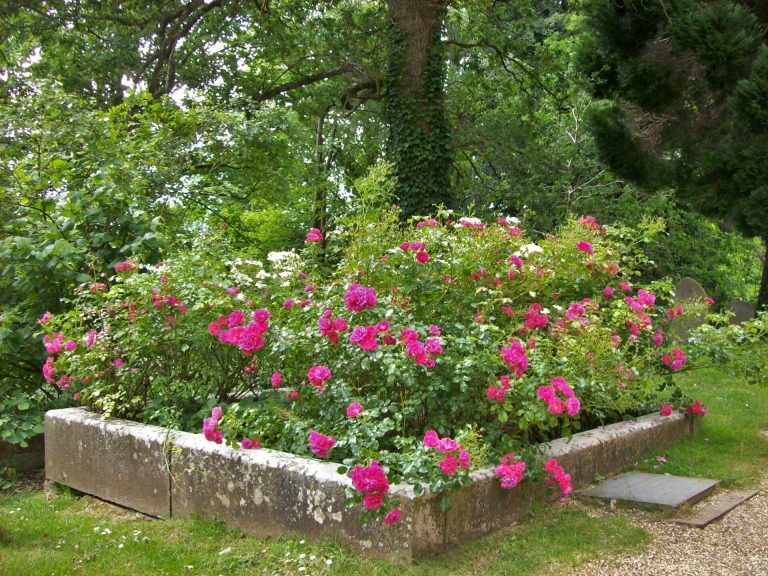
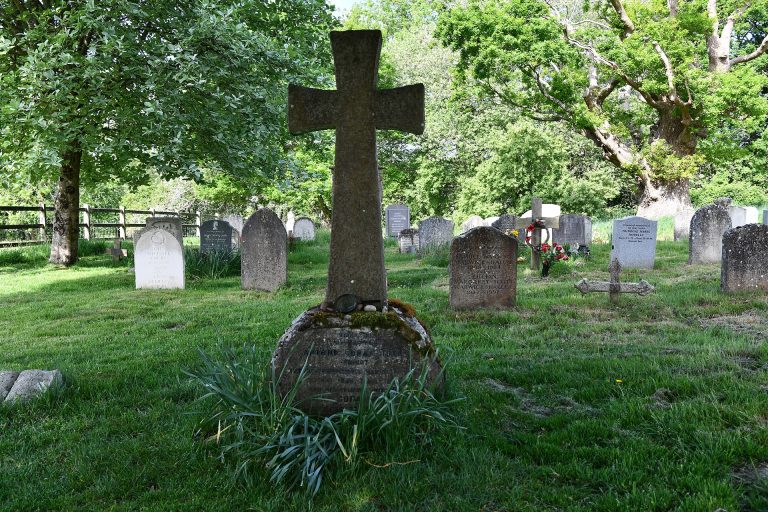
Outside, on the south side of the church, is the Hargreaves family grave where the ashes of Alice Hargreaves, the real Alice of Lewis Carroll’s stories, were buried after her death in 1934. It is a simple stone, as she wanted. Her story is on our Alice Liddell page.
Visiting St Michael’s: opening, access and parking
The church is on the High Street at the top of the village, postcode SO43 7BD. It is normally open daily from 10am to 4pm, though the volunteers who unlock it sometimes open later or close earlier, and entry is free, with donations welcome. Services take priority, so check the parish website on Sundays and for weddings and funerals. The church guidebook and the windows booklet were £6 each, or £10 for both, at the time of writing (autumn 2026).
There is level access into the main parts of the church. The nearest public toilets, including an accessible one, are in the main car park by the Heritage Centre, about five minutes’ walk away, and that car park is the easiest place to leave the car. See our parking guide and accessibility guide for details. If you have a dog with you, ask before taking it inside.
For lunch, the Fox & Hounds is a short walk down the High Street, and the White Rabbit on Romsey Road, a Chef & Brewer pub named after Carroll’s rabbit, serves food all day. Our cafés and pubs pages have more. The church is a good stop on a wet afternoon too; our rainy day itinerary has more ideas.
Frequently asked questions
Who designed St Michael’s church in Lyndhurst?
William White, who designed it in 1858. It was built over roughly the next ten years.
Which windows are by Morris and Burne-Jones?
The east window (the New Jerusalem, 1862 to 1863) and the south transept window (answers to prayer, 1863). Both were made by Morris’s firm with figures designed by Burne-Jones.
Where is Alice Liddell’s grave?
Outside the church, on the south side, in the Hargreaves family grave.
Is the church free to visit?
Yes. It is usually open from 10am to 4pm, and donations help with the upkeep of a Grade I building.
For the rest of the village’s story, see our Lyndhurst history page.