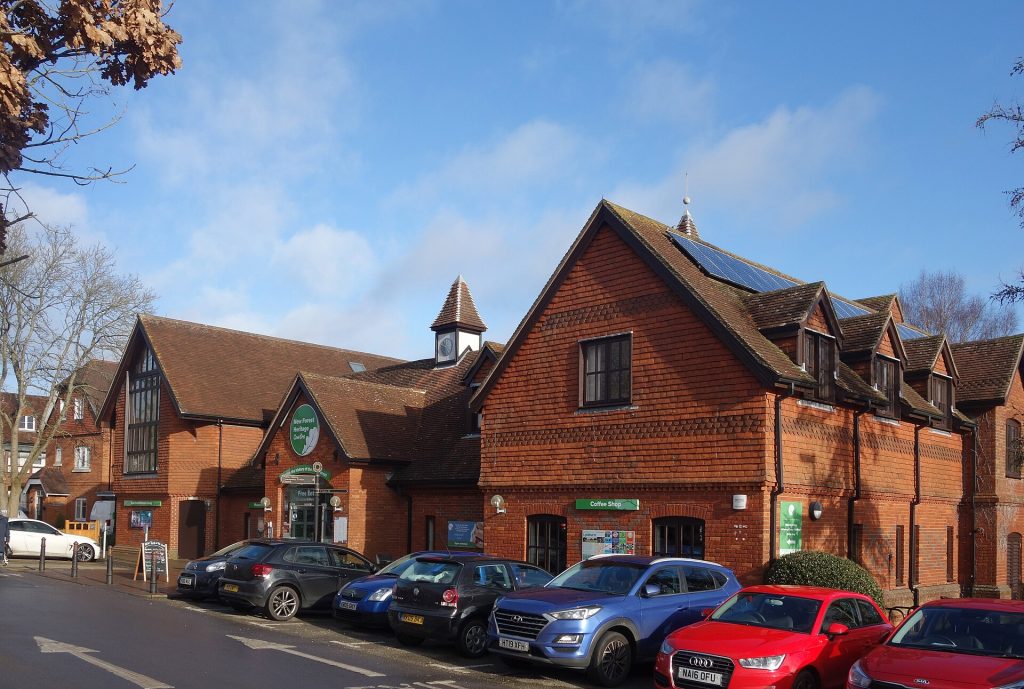
The New Forest Heritage Centre is the free museum at the back of Lyndhurst’s main car park, and if you only do one indoor thing in the village, do this. Give it an hour and you’ll come out knowing who owns the ponies, why the Forest still has its own court, and how a Norman hunting ground turned into a National Park. There’s a café, a shop that sells proper maps, and a reference library holding the best collection of New Forest maps you’ll find anywhere.
An independent charity runs the centre. Entry is free for everyone, and the donations box by the door helps keep it that way.
What’s inside the New Forest Heritage Centre
The museum galleries are about the Forest’s people: the old forest laws (a few still apply), the traditions behind the ponies and cattle on the roads, and the industries that shaped the woods and heaths. They also answer the two questions every visitor asks, which are where the name came from and whose ponies those are on the road. A wildlife and conservation section covers how the Forest is protected today and the pressures on it. It’s a small museum and it doesn’t pretend to be anything bigger, but it’s well done, and it makes the rest of your time in the Forest more interesting.
For children there are free museum trails, activity sheets and colouring sheets, plus family activities in the school holidays.
The New Forest Embroidery
Upstairs in the Upper Gallery hangs the piece most people remember. The New Forest Embroidery is 7.5 metres long and runs through about 900 years of Forest history, from William the Conqueror’s royal forest to the present day, in four panels. Lady Belinda Montagu designed it and made it over two years with a group of about 60 volunteers. Don’t rush it. Walk the length of it slowly, then go back to the bits that caught your eye.
Exhibitions, talks and workshops
There’s a changing exhibition alongside the permanent displays. At the time of writing (autumn 2026) it’s War Graves of the New Forest, about people from both World Wars buried in Forest churchyards, on until 29 November 2026. Local history groups give talks through the year (a small charge covers the room), and there are occasional paid workshops, such as a Christmas linocut day on 14 November 2026. On Wednesday afternoons the Memory Works group meets for people living with dementia, and carers are welcome to wait in the café.
The Christopher Tower Reference Library and archive
The library is named after Christopher Tower, a scholar and former diplomat who took up the New Forest late in life. It holds around 50,000 books, manuscripts, maps and bits of ephemera, and if you’re researching a family, a house or a Forest village, start here. The collections include papers from the bodies that have governed the Forest, natural history notes by the naturalist and film-maker Eric Ashby, drawings and carvings by the local artist Tom Charman, forestry records and recorded oral histories.
The maps are what I’d go for. The best known is the Drivers’ Map of 1789, published by William Faden for a parliamentary report and named after two of its surveyors. It marks the timber inclosures and colours in the Crown leases and the small encroachments that later grew into villages like Burley and East Boldre. A digitised copy is on the centre’s website if you want a look before you come.
The library opens Monday to Friday, by appointment only. Email library@newforestheritage.org.uk or ring 023 8028 6150 with what you’re researching and, if you can, the items you’d like to see.
Café, gift shop and tourist information
The café does sandwiches, soup, scones and cakes, with gluten-free and vegan options and smaller portions for children. A lot of it is local: River Coffee, New Forest Tea Co, Little Bee Bakery and New Forest Ice Cream are all on the list. It holds the Kids in Museums Family Café Standard, staff will warm a bottle, and there’s space for buggies and wheelchairs.
The gift shop is where I’d buy a map before heading out. It stocks the National Park’s cycling and walking map, local books, and honey and other produce from New Forest Marque members.
The brown signs on the roads into Lyndhurst point to the “visitor information centre”, and this is where they lead. There’s a welcome desk just inside the step-free entrance, with leaflets, guidebooks and maps, and the Verderers point people here for leaflets about their work too. For travel and practical questions before you set off, see our plan your visit section.
Opening hours and admission
| What | Details (autumn 2026) |
|---|---|
| April to October | 10am to 5pm, every day |
| November to March | 10am to 4pm, every day |
| Admission | Free, donations welcome |
| Library and archive | Monday to Friday, by appointment |
| Café closed | 25 and 26 December, 1 January |
These are the centre’s own published times at the time of writing. Before a special trip, especially around Christmas, check newforestheritage.org.uk or ring 023 8028 3444. Groups of more than six should contact the office first. Self-led groups of up to 30 are welcome, with a suggested donation of £2 to £4 a head.
Parking next door to the Heritage Centre
The centre sits on the edge of Lyndhurst’s main car park, behind the High Street (satnav SO43 7NY). New Forest District Council runs it, and it’s big: 249 long-stay spaces, 50 short-stay spaces with a three-hour limit, and 16 disabled bays, several of them right by the centre’s door. There are public toilets in the car park and four electric vehicle charging points.
| Stay | Charge (2026 tariff) |
|---|---|
| Up to 1 hour | £1.55 |
| Up to 2 hours | £3.20 |
| Up to 3 hours | £3.85 |
| Up to 4 hours (long stay) | £4.35 |
| Up to 5 hours (long stay) | £5.40 |
| Up to 20 hours (long stay) | £8.60 |
Pay with coins, contactless or the RingGo app (location 2579). It fills up on sunny summer weekends, so come early if you can. Our Lyndhurst parking guide has the alternatives.
By bus or bike
The Breezer 86 bus (Southampton to Lymington via Lyndhurst and Brockenhurst) stops at several points around the village, all a short walk away. In summer the open-top New Forest Tour starts in Lyndhurst and its stop is right beside the centre (in 2026 it ran from 4 July to 13 September). Cyclists will find bike racks on the side of the building.
Accessibility at the Heritage Centre
- The main entrance is step-free, with the welcome desk just inside.
- A lift in the gift shop, near the café, goes up to the Upper Gallery. Staff and volunteers can help.
- There are two accessible toilets, one on each floor, with baby changing in the downstairs one.
- You can borrow an adult wheelchair for free. Ask at reception or let the centre know in advance.
- Large-print guides cover the permanent displays, and Sensory Explorer bags (kept by the lift) can be signed out.
- A Visual Story guide to the visit can be downloaded from the centre’s website, and the upstairs area is quiet with comfortable seats.
- Dogs are welcome in the museum, gallery, shop and café. Only assistance dogs may go into the library and archive.
The centre sits at one end of a short village loop. Walk up the High Street to St Michael and All Angels Church for the Leighton fresco and Alice Liddell’s grave, then the King’s House next door, home of the Verderers’ Court. The Bolton’s Bench walk starts about five minutes away. On a wet day the centre is the backbone of our rainy day plan, and there’s more on our things to do in Lyndhurst and free things to do pages.
Frequently asked questions
Is the New Forest Heritage Centre free?
Yes. The museum and gallery are free for everyone, and donations are welcome. You’ll pay for the car park outside, the café and shop, and some talks and workshops.
Can I bring my dog?
Yes. Dogs are welcome in the museum, gallery, gift shop and café. Only assistance dogs are allowed in the library and archive.
How long do I need?
About an hour for the museum and the Embroidery. Allow longer for the café or a library appointment.
Can older children visit on their own?
Young people aged 14 and over can visit unaccompanied. Children aged 13 and under need to be with a parent or guardian aged 16 or over.
Is it open on Sundays?
Yes, every day: 10am to 5pm from April to October and 10am to 4pm from November to March.